

Banks and NBFCs Lead Newsroom Headlines on 25 October 2026: Market Scan
Quick answer
Financials, tech, and quarterly results dominated newsroom coverage on 25 October 2026. Here is what the media buzz signals for Indian equity investors today.
Generated from exchange and market-data feeds by the TrendRipperX Data Desk. Prices can be delayed; this report describes price moves and does not claim to know why a stock moved.

Quick summary
banks and NBFCs
11 headlines
4 publishers
technology and IT
7 headlines
4 publishers
quarterly results
7 headlines
3 publishers
The stories moving markets — 25 October 2026
When institutional liquidity flows across Dalal Street, newsrooms become a real-time heatmap of market sentiment. Across the major business newswires tracked at 03:05 pm IST, banks and NBFCs stands out as the single most-covered theme in the closing session on 25 October 2026, capturing 4 publishers and 11 headlines. Tech services, corporate earnings, industrial supply constraints, and primary market activity are closely trailing behind.
Understanding media density is not about chasing yesterday's news; it is about assessing whether a price driver is already fully absorbed by trading desks. When a theme achieves near-universal coverage across four independent editorial desks, price action frequently reflects those narrative inputs. For individual investors, the crucial exercise lies in separating fully priced headline chatter from emerging structural trends before the trading bell rings for the next session.
Below is the structured breakdown of the primary themes moving financial media, paired directly with live TrendRipperX data feeds read at 03:05 pm IST.
Themes in focus
Banks and NBFCs
4 publishers and 11 headlines in the last session. That is near-universal coverage across the desks we track, which normally means the story is already reflected in prices.
Credit growth, deposit costs and asset quality drive nearly a third of index earnings, so bank news travels straight into the broader market. When banking tickers come under intense newsroom scrutiny, equity benchmarks rarely remain static. The systemic weight of high-street lenders like Kotak Mahindra Bank, State Bank of India, HDFC Bank, and ICICI Bank ensures that any shift in liquidity conditions, deposit pricing strategies, or quarterly performance metrics reverberates across the entire domestic financial landscape.
Beyond corporate earnings, retail banking dynamics are taking center stage. From branch calendar disruptions around festive dates to structural personal finance strategies like fixed deposit laddering, investors and depositors alike are evaluating how interest rate cycles impact yield generation and liquidity management.
Live numbers: Banking & Finance, Bank Nifty today.
Technology and IT
4 publishers and 7 headlines in the last session. That is near-universal coverage across the desks we track, which normally means the story is already reflected in prices.
IT services revenue is dollar-linked and deal-driven, so technology news is read together with the rupee and US client spending. The software sector is facing a multi-pronged transition. Globally, enterprise clients are reallocating capital budgets toward artificial intelligence, forcing major global technology firms like Microsoft, Google, Oracle, and Meta to restructure headcount while workforce rationalization approaches 2 lakh globally in 2026.
Domestically, this technological shift is pushing educational institutions and academic policymakers, including BITS Pilani and NCERT, to introduce foundational modules on artificial intelligence and computational thinking for secondary and higher education. For equity investors, tracking these structural workforce realignments provides essential context on how Indian IT exporters will manage talent costs and digital service margins in upcoming quarters.
Live numbers: Technology, Market dashboard.
Quarterly results
3 publishers and 7 headlines in the last session. Three independent desks running the same story usually means it has legs beyond a single day.
Earnings season coverage concentrates on revenue growth, margin direction and guidance — the three inputs that reset a stock's multiple. During mid-season reporting, market volatility tends to spike sharply around individual corporate announcements. High-profile names undergoing significant drawdowns — such as Suzlon Energy crashing 39% from its 52-week high — showcase how aggressively markets repriced expectations ahead of Q2 results 2026.
At the same time, earnings performance dictates primary market valuations for new entrants like EAAA India Alternatives, where investors are forced to balance steady fee-based recurring income models against underlying profit volatility. When quarterly numbers fail to confirm lofty growth trajectories, equity multiples contract swiftly across both public equities and upcoming initial public offerings.
Live numbers: Quarterly results.
Industry and sectors
3 publishers and 4 headlines in the last session. Three independent desks running the same story usually means it has legs beyond a single day.
Sector-level cost, capacity and policy news moves whole baskets of stocks at once rather than one name. In the industrial and materials domain, structural growth plans often collide with raw material availability. JSW Steel highlighting domestic raw material bottlenecks comes at a time when national infrastructure goals envision expanding national steel capacity toward 600 mt.
Meanwhile, secondary market costs, precious metal retail rates across major cities for 24K, 22K, 18K gold and 999 silver, and regulatory updates — such as GST tribunal rulings enabling tax refunds for airlines when passenger fares are returned — directly impact operational economics and consumer liquidity.
Policy and macro data
3 publishers and 4 headlines in the last session. Three independent desks running the same story usually means it has legs beyond a single day.
Rate, inflation and fiscal data reset the discount rate applied to every listed cash flow, which is why macro prints move the whole board at once. Regulatory clarity from institutional custodians remains critical for large conglomerate holding structures. Clarifications regarding RBI Governor Sanjay Malhotra's public statements on the Sept 11 regulatory framework surrounding high-profile corporate entities like Tata Sons give market participants crucial policy visibility.
Simultaneously, institutional infrastructure upgrades — such as the Prime Minister inaugurating the central bank's dedicated data centre in Bhubaneswar — underscore ongoing modernization of monetary and financial systems, directly affecting banking operational efficiency.
Live numbers: Economy, Stock market today.
- PM Modi to inaugurate RBI's data centre in Bhubaneswar — Economic Times
IPOs
2 publishers and 5 headlines in the last session. Coverage is still limited to a couple of desks, so the story is early and may not be priced in yet.
Primary-market coverage clusters when subscription numbers or grey-market premiums move, because both are read as demand proxies before listing day. High-profile offerings like Reliance-backed Jio Platforms dominate primary market dialogue, where grey market premiums signaling potential 22% listing gains drive retail subscription rushes and intense portal activity around allotment checks on registrar platforms such as KFin Tech.
At the same time, institutional alternative investment management offerings, including EAAA India Alternatives, require buyers to carefully evaluate steady recurring fee streams against potential top-line fluctuations prior to placing capital bids.
Mutual funds
2 publishers and 5 headlines in the last session. Coverage is still limited to a couple of desks, so the story is early and may not be priced in yet.
Fund flows decide how much domestic money is available to absorb foreign selling, and SIP or NFO news usually shows up in mid- and small-cap breadth first. Retail compounding strategies remain a foundational pillar supporting domestic equity valuations. Heuristic concepts like the popular 15-15-15 rule — demonstrating how a ₹15,000 monthly systematic investment plan can compound toward ₹1 crore over long time horizons — continue to pull sustained retail flows into equity asset classes.
Simultaneously, retail investors are evaluating historical performance consistency across 1 vs 3 vs 5 years investment cycles in 2026 to select disciplined fund management styles, such as those overseen by experienced portfolio leads like Paresh Jain at Baroda BNP Paribas Mutual Fund.
Live numbers: Mutual fund NAV, Mutual funds.
The TrendRipperX view
Our institutional perspective on high-density news cycles rests on a simple trading floor principle: heavy media coverage often marks the late stage of price discovery rather than its inception. When a single sector like banking attracts 11 headlines across four distinct editorial desks, market participants must assume that initial earnings expectations and liquidity inputs are already embedded in current quotes.
For disciplined equity allocation, the optimal edge lies in identifying structural divergence between headline noise and valuation realities. When corporate names experience severe price drawdowns — such as a 39% decline from 52-week highs during quarterly reporting — emotional retail selling often creates mispricings that long-term capital can evaluate objectively. Similarly, while primary market excitement generated by initial public offerings carrying estimated 22% listing gains creates significant media momentum, sustainable long-term returns depend entirely on post-listing balance sheet execution rather than short-term grey market premiums.
Rather than chasing thematic news clusters after multiple publishers have amplified the narrative, intelligent market participants use media scans to verify where market consensus sits today — and where market surprises might originate tomorrow.
Why this matters to you
Whether you manage an active direct equity trading desk, run regular monthly mutual fund investments, or build conservative bank deposit laddering structures, thematic news density directly influences your capital decisions:
- For Long-Term Equity Investors: High media coverage in quarterly earnings means valuation multiples are being repriced rapidly. When high-beta stocks face deep pullbacks from 52-week highs during earnings announcements, long-term investors should evaluate underlying balance sheet health and raw material cost dynamics rather than panicking over daily volatility.
- For IPO Applicants & Short-Term Traders: Grey market indicators suggesting listing pops (such as a 22% bump) reflect immediate liquidity demand, but institutional allotment procedures via registrars like KFin Tech dictate execution risk. Relying solely on headline sentiment without inspecting operating cash flows leaves capital exposed once listing day turnover clears.
- For Mutual Fund & SIP Allocators: Wealth accumulation frameworks like the 15-15-15 rule rely on discipline across multi-year cycles. Examining performance metrics across 1 vs 3 vs 5 years horizons ensures your monthly ₹15,000 SIP allocations remain anchored in fund manager execution rather than short-term fund marketing.
- For Fixed-Income & Cash Savers: Liquidity management tools, including fixed deposit laddering and tracking central bank calendar disruptions across 3 non-banking days, prevent unexpected cash flow bottlenecks while optimizing yield during shifting rate regimes.
How to read these numbers
Understanding how media density maps onto market execution requires a disciplined framework. Here is how market veterans interpret thematic news counts:
- Publisher Consensus vs Single-Desk Rumors: When four separate publishing desks run the same overarching story (such as banking sector liquidity or tech sector restructuring), the theme is universally recognized by market participants. Do not expect easy information asymmetry.
- Headline Volume as a Volatility Indicator: A concentration of 7 to 11 headlines within a single sector indicates high trading desk interest and upcoming order flow. Expect wider intraday price ranges and elevated trading volumes in associated tickers.
- Divergence Between News and Price: If news coverage is overwhelmingly positive but ticker prices stall or fall, institutional smart money is likely distributing shares into retail buying enthusiasm. Conversely, if negative headlines fail to drive prices lower, downside support has likely formed.
Beginner's guide: Understanding primary and secondary market terms
To navigate financial news reports effectively, beginners must understand key financial concepts used across trading desks:
- Grey Market Premium (GMP): An informal price premium at which unlisted initial public offering shares trade in unofficial off-market channels prior to official stock exchange listing. A 22% GMP indicates that off-market participants are paying a premium over the official issue price, though it carries no legal guarantee of listing day performance.
- FD Laddering: A structured deposit investment technique where an investor divides total savings across multiple fixed deposits maturing at different dates. This strategy provides regular liquidity access while reducing the risk of locking all capital into a low interest rate cycle.
- 52-Week High/Low Range: The highest and lowest transaction price at which a stock traded on an exchange over the previous 52 weeks. When a ticker drops 39% from its 52-week peak, it signals significant price re-rating that requires fundamental re-examination.
Frequently asked questions
Which market theme had the highest coverage in the closing session on 25 October 2026?
Banks and NBFCs led all market coverage in the closing session on 25 October 2026, generating 11 headlines across 4 independent publishers.
What global factor is currently impacting technology and IT news?
Global technology desks are reporting global job cuts approaching 2 lakh in 2026 as global tech giants including Microsoft, Google, Oracle, and Meta pivot capital expenditure toward artificial intelligence.
What key primary market event is currently attracting high investor focus?
The Reliance-backed Jio Platforms initial public offering is attracting primary market focus, with grey market indicators hinting at potential 22% listing gains while investors monitor online allotment status checks via the KFin Tech registrar portal.
What personal finance strategy is recommended for managing bank fixed deposit returns?
Bank fixed deposit laddering is highlighted as a systematic method to maximize deposit returns, manage interest rate risks, and improve portfolio liquidity across changing interest rate environments.
How much can a monthly SIP of ₹15,000 grow according to popular wealth creation rules?
According to the 15-15-15 personal finance rule, a monthly systematic investment plan of ₹15,000 can potentially grow to an estimated capital pool of ₹1 crore over long-term investment periods.
How to use this round-up
Coverage volume tells you where attention is, not where value is. Use it to decide what to check — then read the level on the live page, compare it with the previous close and the day range, and only then judge whether the market has already priced the story. Headlines below link to the publishers; every number on TrendRipperX is read from the exchange, association or official source directly.
Key takeaways
- banks and NBFCs: 11 headlines (4 publishers)
- technology and IT: 7 headlines (4 publishers)
- quarterly results: 7 headlines (3 publishers)
About this report
Every figure on this page is read from a primary source at the timestamp shown — exchange boards for equities and indices, the exchange bid book for IPOs, published association rates for bullion, and consolidated exchange quotes for crypto — with no estimation or third-party commentary. Historical fields such as trailing returns and 52-week extremes are computed on the adjusted daily series so splits and bonuses do not create false gaps. A timestamp outside market hours reflects the last traded or last published value, not a live tick.
Related live pages
Sources
- Theme detection from the public RSS feeds of Livemint, Moneycontrol, The Economic Times, Business Standard and The Hindu BusinessLine — headlines linked to the publisher
- All prices and levels from our own exchange, bullion association and official data feeds
“This report is generated automatically from live exchange and official association data at the time stamped above. Prices move continuously — verify on the source before acting. Nothing here is investment advice.”
Comments
Comments are moderated. Be civil, no stock tips or promotions.
Loading comments…
Written by TrendRipperX Data Desk. Figures come from exchange, company and market-data sources linked in the story. Spotted an error? Tell the newsroom — see our corrections policy and editorial policy.
For information only, not investment advice. TrendRipperX is not a SEBI-registered adviser. Full disclaimer.
Related articles

Why Banks And NBFCs Is the Most-Covered Market Story This Midday — 25 October 2026
The most-covered market themes in the midday session on 25 October 2026 — banks and NBFCs, IPOs, telecom — with our live numbers for each and links to the publishers running the story.

Why Banks And NBFCs Is the Most-Covered Market Story This Morning — 25 October 2026
The most-covered market themes in the morning session on 25 October 2026 — banks and NBFCs, quarterly results, gold — with our live numbers for each and links to the publishers running the story.
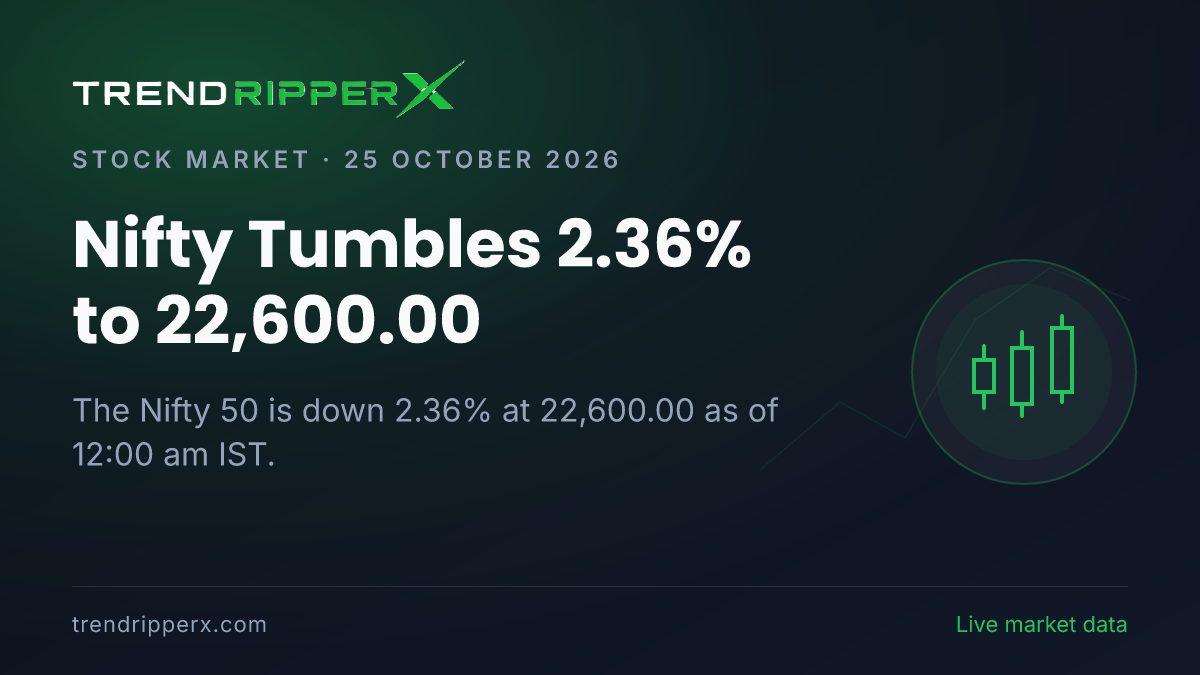
Breaking: Nifty Tumbles 2.36% to 22,600.00 on 25 October 2026
The Nifty 50 is down 2.36% at 22,600.00 as of 12:00 am IST. Live breadth, sector damage and the biggest movers behind the move.
Newsletter