

Maruti Suzuki Q1 Results: Profit Falls 9% YoY Despite Record Sales; Revenue Rises 36%
Quick answer
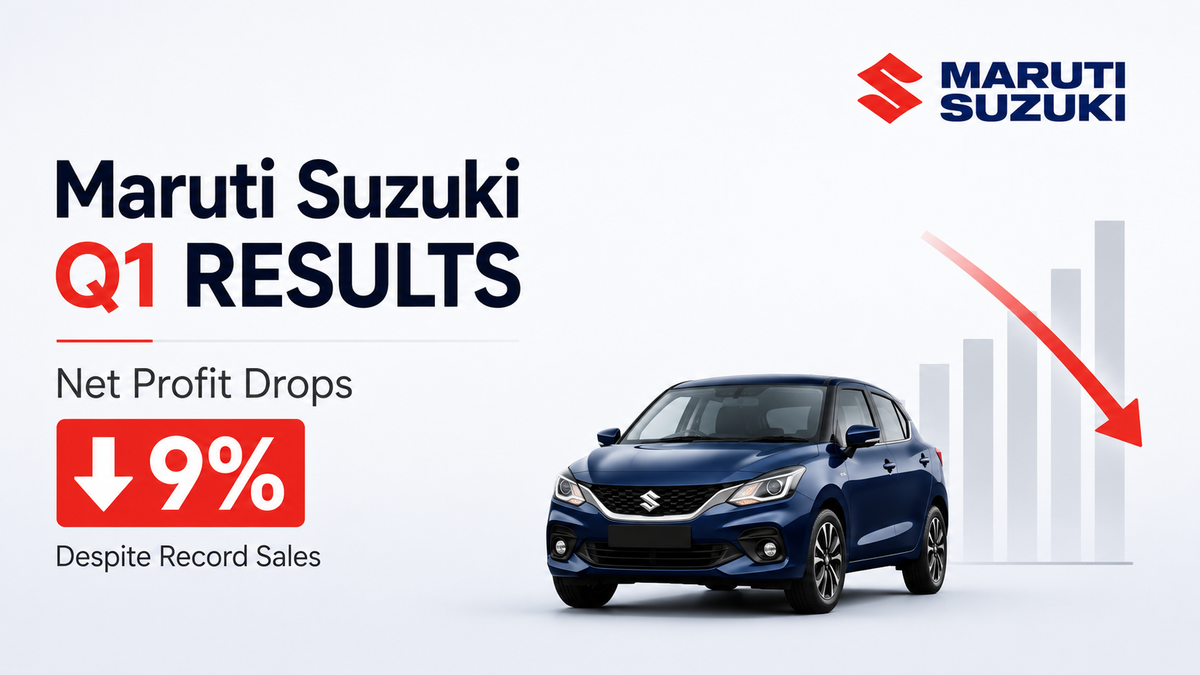
Maruti Suzuki reported a 9% decline in Q1 FY27 net profit despite achieving record quarterly sales. Revenue rose 36% year-on-year, while higher input costs and margin pressure impacted profitability.
Maruti Suzuki Q1 Results FY27
Maruti Suzuki India Ltd. reported a mixed set of financial results for the quarter ended June 30, 2026 (Q1 FY27). While the company achieved record quarterly vehicle sales and strong revenue growth, higher raw material costs and operating expenses weighed on profitability.
The company reported a consolidated net profit of ₹3,446.9 crore, down 9.1% year-on-year from ₹3,792 crore in the corresponding quarter last year. On a sequential basis, profit declined 5.8% compared to the March quarter.
Despite the decline in earnings, revenue from operations increased 35.9% year-on-year to ₹52,469 crore, reflecting strong demand across domestic and export markets.
Key Financial Highlights
Margin Pressure Weighs on Profitability
Although revenue remained strong, profitability came under pressure due to rising costs.
Total expenses increased 40.5% year-on-year to nearly ₹50,000 crore, growing faster than revenue.
Raw material expenses surged 45.9% to ₹32,013 crore, while employee benefit expenses and other operating costs also increased during the quarter.
The company noted that material costs rose sharply during the period, particularly amid geopolitical disruptions, resulting in lower operating margins.
Record Sales Performance
Maruti Suzuki delivered its highest-ever quarterly sales during the June quarter.
Total sales reached 682,724 units, representing a 29.3% year-on-year increase.
Key sales highlights include
The strong performance was supported by the commissioning of the company's second manufacturing facility at Kharkhoda.
Dealer inventory remained healthy at approximately 13 days at the end of the quarter.
Price Hike Announced
Ahead of the quarterly results, Maruti Suzuki announced a price increase of up to ₹30,000 across its vehicle portfolio, effective from August 2026.
The company cited persistent inflationary pressures and higher input costs as the primary reasons for passing a portion of the increased costs on to customers.
Key Takeaways
Net profit declined despite strong revenue growth.
Revenue increased nearly 36% year-on-year.
Quarterly vehicle sales reached a record high.
Domestic market share improved to 41.2%.
Rising raw material costs impacted operating margins.
Price hike introduced to partially offset cost inflation.
Outlook
Maruti Suzuki continues to maintain its leadership position in India's passenger vehicle market with strong sales momentum and expanding manufacturing capacity.
However, investors will closely monitor raw material costs, operating margins, pricing strategy, and consumer demand in the coming quarters to assess the company's profitability outlook.
Disclaimer
This article is published solely for educational and informational purposes and should not be considered financial, investment, legal, or tax advice. The information presented is based on publicly available sources and is believed to be accurate at the time of publication; however, TrendRipperX does not guarantee its completeness or accuracy.
TrendRipperX is not registered with the Securities and Exchange Board of India (SEBI) as an Investment Adviser or Research Analyst. Any views expressed are for informational purposes only and do not constitute a recommendation to buy, sell, or hold any security.
Investments in financial markets are subject to market risks. Readers should conduct their own research and consult a SEBI-registered financial advisor before making any investment decisions.
Frequently asked questions
What is the latest update on MARUTI?
Maruti Suzuki reported a 9% decline in Q1 FY27 net profit despite achieving record quarterly sales. Revenue rose 36% year-on-year, while higher input costs and margin pressure impacted profitability.
How did maruti Suzuki Q1 Results FY27 perform this quarter?
Maruti Suzuki India Ltd. reported a mixed set of financial results for the quarter ended June 30, 2026 (Q1 FY27). While the company achieved record quarterly vehicle sales and strong revenue growth, higher raw material costs and operating expenses weighed on profitability.
What should you know about key Financial Highlights?
Consolidated Net Profit: ₹3,446.9 crore (down 9.1% YoY). Revenue from Operations: ₹52,469 crore (up 35.9% YoY). Net Sales: ₹49,959 crore (up 36% YoY). EBITDA: ₹4,313 crore. EBITDA Margin: 8.9% (down from 11.6% last year).
How did margin Pressure Weighs on Profitability perform this quarter?
Although revenue remained strong, profitability came under pressure due to rising costs.
What is happening with record Sales Performance?
Maruti Suzuki delivered its highest-ever quarterly sales during the June quarter.
How is price Hike Announced moving right now?
Ahead of the quarterly results, Maruti Suzuki announced a price increase of up to ₹30,000 across its vehicle portfolio, effective from August 2026.
Comments
Comments are moderated. Be civil, no stock tips or promotions.
Loading comments…
Related articles

Technology And IT Leads the Morning Market Talk on 15 September 2026, Gold and Pharma And Healthcare Close Behind
The most-covered market themes in the morning session on 15 September 2026 — technology and IT, gold, pharma and healthcare — with our live numbers for each and links to the publishers running the story.

Breaking: Nifty Tumbles 1.00% to 23,398.10 on 15 September 2026
The Nifty 50 is down 1.00% at 23,398.10 as of 12:00 am IST. Live breadth, sector damage and the biggest movers behind the move.

Evening Market Buzz, 14 September 2026: Industry And Sectors Tops the Coverage Ahead of Energy And Power and Technology And IT
The most-covered market themes in the evening session on 14 September 2026 — industry and sectors, energy and power, technology and IT — with our live numbers for each and links to the publishers running the story.
Newsletter