

South Korean KOSPI Crashes 38.5% From Record High: AI Bubble Burst, Chip Sell-Off and US-Iran Tensions Weigh on Markets
Quick answer
South Korea's KOSPI index has plunged 38.5% from its June 2026 record high amid an AI-driven technology sell-off, semiconductor weakness, geopolitical tensions, and rising concerns over Chinese competition.
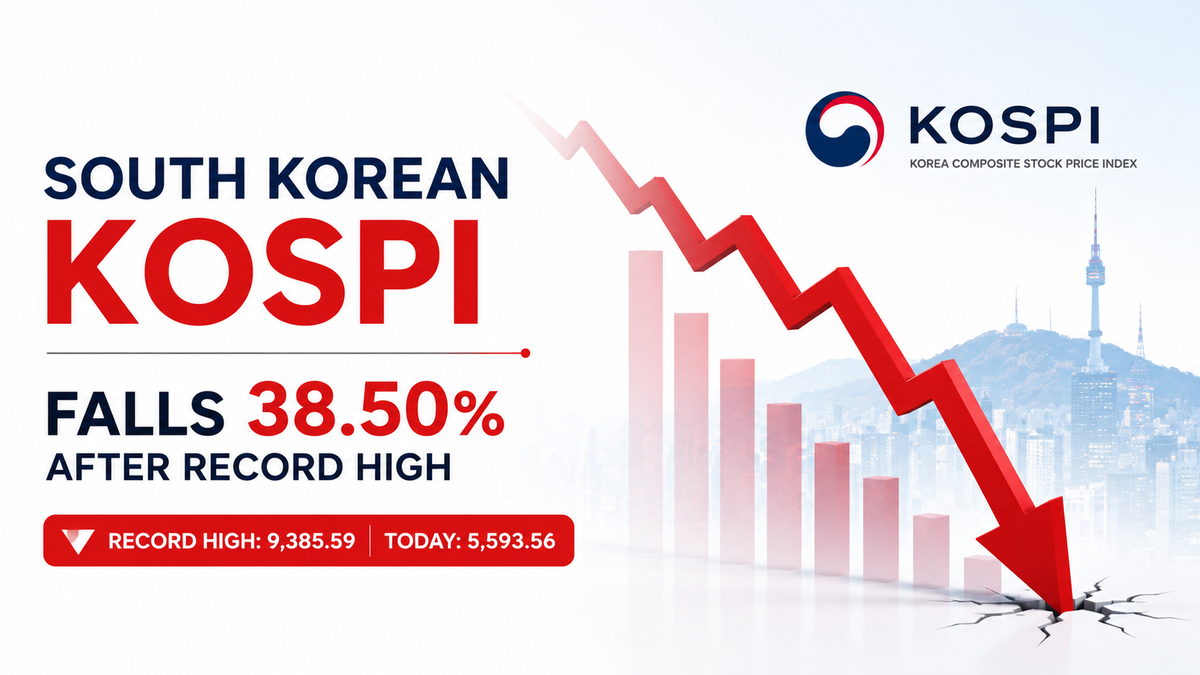
South Korean KOSPI Enters Sharp Correction
South Korea's benchmark KOSPI Index has witnessed one of its sharpest declines in recent years after reaching a historic record high in June 2026.
After climbing to an all-time high of 9,385.59 on 22 June 2026, the index has fallen sharply as investors booked profits and exited technology-heavy stocks amid rising global uncertainty.
The KOSPI closed at 5,593.56 on 30 July 2026, representing a decline of approximately 38.5% from its post-record closing level.
The correction reflects growing concerns over the global AI sector, semiconductor stocks, geopolitical risks and slowing investor sentiment across Asian equity markets.
KOSPI Performance Snapshot
Key Market Numbers
Record High: 9,385.59
22 June Closing: 9,114.55
30 July Closing: 5,593.56
Decline Since June 22: 38.5%
The index has remained under sustained selling pressure after reaching record levels in late June.
Why Is the KOSPI Falling?
Market participants attribute the correction to multiple factors rather than a single event.
- AI Bubble Concerns
The sharp rally in artificial intelligence-related companies has reversed globally.
As investor optimism faded, technology stocks experienced widespread profit booking, placing significant pressure on South Korea's technology-heavy market.
- Semiconductor Sell-Off
South Korea is home to several major semiconductor companies.
Weakness across global chip stocks has resulted in heavy selling in Korean technology shares, making the semiconductor sector one of the biggest contributors to the market decline.
Experts noted that similar pressure has also been visible in major global technology indices.
- US-Iran Geopolitical Tensions
Renewed geopolitical tensions involving the United States and Iran have increased global market uncertainty.
Higher crude oil prices and fears of prolonged conflict have reduced investor appetite for risk assets across international markets.
- Rising Competition From China
Market experts also highlighted growing concerns over increasing competition from Chinese semiconductor manufacturers.
Investors remain cautious following developments involving Chinese memory chip producers, raising questions about future market share and profitability for Korean technology companies.
What Market Experts Say
Investment professionals believe the recent correction reflects elevated volatility within the South Korean equity market.
According to market participants, technology and semiconductor stocks continue to face valuation pressure as investors reassess expectations for future AI-driven earnings growth.
Experts also noted that geopolitical uncertainty and higher energy prices have further weakened overall market sentiment.
Is This a Buying Opportunity?
While valuations have become more attractive after the sharp correction, several investment professionals remain cautious.
Many believe the current volatility makes aggressive buying difficult until market stability improves.
Investors are expected to closely monitor
These factors are likely to determine the next direction of the KOSPI.
What This Means for Investors
The sharp decline in South Korea's KOSPI highlights how quickly market sentiment can reverse after strong rallies, particularly in technology-driven markets.
Weakness in AI-related stocks, semiconductor companies and geopolitical uncertainty have combined to trigger significant profit booking. Investors should continue monitoring global technology trends, energy prices and geopolitical developments before making investment decisions, as market volatility may remain elevated in the near term.
Disclaimer
This article is published solely for educational and informational purposes and should not be considered financial, investment, legal, or tax advice. The information presented is based on publicly available sources and is believed to be accurate at the time of publication; however, TrendRipperX does not guarantee its completeness or accuracy.
TrendRipperX is not registered with the Securities and Exchange Board of India (SEBI) as an Investment Adviser or Research Analyst. Any views expressed are for informational purposes only and do not constitute a recommendation to buy, sell, or hold any security.
Investments in the securities market are subject to market risks. Readers should conduct their own research and consult a SEBI-registered financial advisor before making any investment decisions.
Frequently asked questions
What is the news about South Korean KOSPI Crashes 38.5% From Record High: AI Bubble Burst, Chip Sell-Off and US-Iran Tensions Weigh on Markets?
South Korea's KOSPI index has plunged 38.5% from its June 2026 record high amid an AI-driven technology sell-off, semiconductor weakness, geopolitical tensions, and rising concerns over Chinese competition.
What should investors know about south Korean KOSPI Enters Sharp Correction?
South Korea's benchmark KOSPI Index has witnessed one of its sharpest declines in recent years after reaching a historic record high in June 2026.
Why Is the KOSPI Falling?
Market participants attribute the correction to multiple factors rather than a single event.
What should investors know about 1. AI Bubble Concerns?
The sharp rally in artificial intelligence-related companies has reversed globally.
What should investors know about 2. Semiconductor Sell-Off?
South Korea is home to several major semiconductor companies.
What should investors know about 3. US-Iran Geopolitical Tensions?
Renewed geopolitical tensions involving the United States and Iran have increased global market uncertainty.
Comments
Comments are moderated. Be civil, no stock tips or promotions.
Loading comments…
Related articles

Global Markets Today: GIFT Nifty slips to 24,175.65 despite gains in Wall Street and Shanghai
Indian markets face a cautious start as GIFT Nifty slides 0.18%, contrasting with a positive overnight session on Wall Street and a significant 1.81% surge in the Shanghai Composite index.
US Stock Market Today: Wall Street Futures Slip as Tech Rout, Iran Tensions and Bond Yields Weigh
Wall Street futures moved lower on August 24 as weakness in technology stocks, elevated bond yields and rising US-Iran tensions weighed on market sentiment. Investors are also watching upcoming US inflation data and oil market developments.

Alibaba Shares Plunge 11% After $10.2 Billion Share Placement to Fund AI Expansion
Alibaba shares fell sharply after the Chinese technology giant announced an HK$80 billion ($10.2 billion) share placement to fund the expansion of its artificial intelligence and cloud infrastructure capabilities. The fundraising comes as the company increases AI-related capital expenditure amid a sharp decline in quarterly net profit.
Newsletter