

Retail F&O Losses Ease to ₹91,685 Crore in FY26, but Frequent Traders Continue to Bear the Brunt
Quick answer
Individual traders' equity derivatives losses declined to ₹91,685 crore in FY26, but average losses increased 2% as participation fell 18%. Sebi's study highlights the risks faced by frequent and options-focused traders.
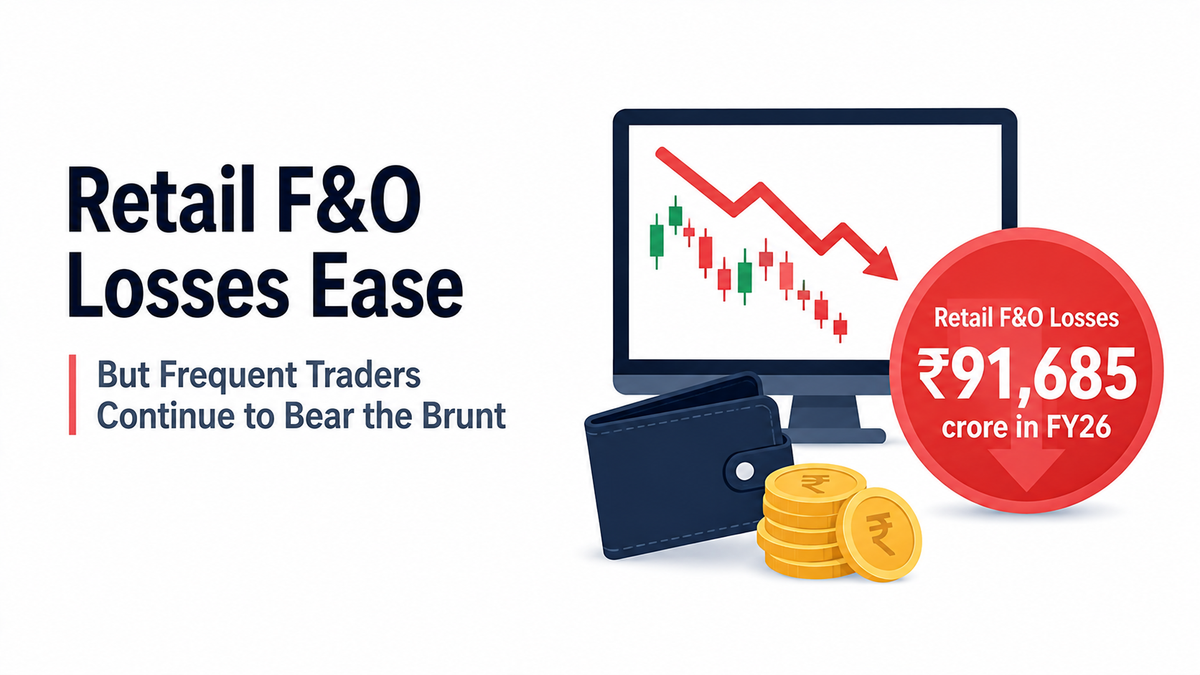
Retail F&O Losses Ease to ₹91,685 Crore in FY26, but Frequent Traders Continue to Bear the Brunt
Losses among individual traders in India's equity derivatives segment remained substantial during FY26, although total losses declined compared with the previous financial year, according to a study released by the Securities and Exchange Board of India (Sebi).
The study showed that individual traders collectively lost ₹91,685 crore in FY26, compared with approximately ₹1.12 trillion in FY25.
However, the decline in overall losses was accompanied by a reduction in participation. The number of individual traders in the derivatives segment fell by 18%, while the average loss per trader increased by 2%.
The findings highlight how frequent participation and options-focused activity continue to be associated with significant losses among individual traders.
Individual Trader Participation Declines
According to the Sebi study, approximately 8.771 million individual traders participated in the equity derivatives segment during FY26.
This represented an 18% decline from the previous financial year.
It was also the first decline in the number of individual traders in the segment since FY16.
Despite fewer participants, losses remained substantial.
The average loss per trader increased from approximately ₹1.13 lakh in FY25 to ₹1.17 lakh in FY26.
Sebi noted that losses declined proportionately less than participation, indicating that the traders who remained active continued to experience significant losses.
87.7% of Individual Traders Reported Losses
The study found that 87.7% of individual traders incurred losses while trading in the derivatives segment during FY26.
This was marginally lower than the 90.9% loss-making rate recorded in FY25.
Although the percentage of traders reporting losses declined, the overall results continue to highlight the challenges faced by individual participants in equity derivatives.
The data also suggests that simply reducing the number of participants does not necessarily translate into a proportionate reduction in losses among the traders who remain active.
Options Buyers Account for Most Participants
Trading activity remained heavily concentrated among options buyers.
According to the study
- 93% of individual traders were classified as "only options buyers".
- Another 4% were classified as "majorly options buyers".
- Around 90% of only-options buyers incurred losses.
- Approximately 75% of majorly-options buyers incurred losses.
Sebi defines only-options buyers as traders who primarily enter positions by buying options and subsequently square them off on trading days.
Majorly-options buyers are traders who engage in option selling on fewer than 50% of their trading days.
The data highlights the significant participation of individuals in options trading and the high proportion of participants who experienced losses.
Frequent Traders Account for Majority of Losses
One of the most notable findings from the study was the relationship between trading frequency and losses.
Traders who were active for more than 100 days accounted for approximately
94% of total turnover
and
87% of total losses
Their average loss was approximately ₹2.76 lakh.
In comparison, traders who participated for 100 days or fewer recorded an average loss of around ₹22,000.
This difference illustrates how frequent market participation can significantly increase cumulative exposure to trading costs, volatility and losses.
Small Traders Also Face Significant Loss Rates
The study found that approximately 77% of traders used peak margins of less than ₹1 lakh.
Among these smaller traders, around 90% incurred losses during FY26.
The data also showed that average losses increased significantly as the amount of capital deployed increased.
Traders using less than ₹10,000 recorded an average loss of approximately ₹5,600.
For traders deploying between ₹10 lakh and ₹1 crore, the average loss increased to approximately ₹9.6 lakh.
The findings indicate that larger capital deployment can result in substantially larger absolute losses when trading outcomes are unfavourable.
Derivatives-Only Trading Is Increasing
The Sebi study also highlighted a growing shift towards derivatives-only participation.
Approximately 1.86 million traders had no turnover in the cash market and participated only in derivatives during FY26.
The number of such traders has increased substantially compared with the period before the Covid-19 pandemic.
This indicates that derivatives have become an increasingly important part of retail market participation, particularly among individuals who may not actively participate in the cash equity segment.
What Does the Sebi Study Highlight?
The latest data provides several important observations about retail participation in India's derivatives market.
1. Overall Losses Have Declined
Individual traders' combined losses fell from around ₹1.12 trillion in FY25 to ₹91,685 crore in FY26.
However, the reduction in losses was accompanied by a much larger decline in participation.
2. Average Losses Increased
Despite fewer participants, average losses per trader increased by approximately 2%.
This suggests that active traders continued to face substantial losses.
3. Frequent Trading Is a Major Factor
Traders active for more than 100 days accounted for 94% of turnover and 87% of losses.
4. Options Dominate Retail Activity
Around 93% of individual traders were classified as only-options buyers.
5. Derivatives-Only Participation Is Growing
Around 1.86 million individuals participated only in derivatives without cash-market turnover during FY26.
Why Frequent Trading Can Increase Risk
Frequent derivatives trading can expose participants to several different risks.
These include
- High transaction frequency
- Brokerage and exchange-related costs
- Market volatility
- Time decay in options
- Leverage
- Rapid price movements
- Emotional decision-making
- Overtrading
- Difficulty maintaining consistent risk limits
When positions are repeatedly opened and closed, even relatively small losses can accumulate over a large number of transactions.
The Sebi data therefore provides an important reminder that trading frequency and activity levels are relevant when evaluating overall trading outcomes.
Key Numbers From the Sebi Study
Total individual trader losses: ₹91,685 crore
Previous-year losses: ₹1.12 trillion
Average loss per trader: ₹1.17 lakh
Change in average loss: +2%
Individual traders in FY26: 8.771 million
Change in participation: -18%
Loss-making individual traders: 87.7%
Only-options buyers: 93%
Majorly-options buyers: 4%
Frequent traders active >100 days: 94% of turnover
Frequent traders' share of losses: 87%
Average loss for >100-day traders: ₹2.76 lakh
Average loss for ≤100-day traders: ₹22,000
Derivatives-only traders: approximately 1.86 million
What Traders Should Keep in Mind
The Sebi findings highlight the importance of understanding the risks associated with leveraged and derivatives-based market activity.
Market participants should consider factors such as
- Position sizing
- Capital allocation
- Trading frequency
- Transaction costs
- Leverage exposure
- Options pricing
- Time decay
- Market volatility
- Risk management
- Personal financial capacity
Past performance or individual trading outcomes cannot guarantee future results.
Key Takeaways
Individual traders lost approximately ₹91,685 crore in equity derivatives during FY26, according to Sebi's latest study.
Total losses declined from around ₹1.12 trillion in FY25, but the number of participating traders also declined by 18%.
The average loss per trader increased approximately 2% to ₹1.17 lakh.
Around 87.7% of individual traders incurred losses in FY26.
Options buyers continued to represent the overwhelming majority of individual participants.
Traders active for more than 100 days accounted for 94% of turnover and 87% of total losses, with an average loss of approximately ₹2.76 lakh.
The study highlights the importance of understanding risk, leverage, trading frequency and transaction costs when participating in the derivatives market.
Disclaimer
This article is published solely for educational and informational purposes.
TrendRipperX is not registered with the Securities and Exchange Board of India (SEBI) as an Investment Adviser or Research Analyst.
The information presented is based on publicly available information and findings reported in Sebi's study.
Nothing in this article should be interpreted as a buy, sell, hold, entry, exit, target or stop-loss recommendation from TrendRipperX.
The statistics and information presented are intended to improve awareness and understanding of risks associated with equity derivatives.
Readers should conduct their own independent research and consult a SEBI-registered financial professional before making any investment or trading decision.
Frequently asked questions
What is the story behind retail F&O Losses Ease to ₹91,685 Crore in FY26, but Frequent Traders Continue to Bear the Brunt?
Individual traders' equity derivatives losses declined to ₹91,685 crore in FY26, but average losses increased 2% as participation fell 18%. Sebi's study highlights the risks faced by frequent and options-focused traders.
What is happening with retail F&O Losses Ease to ₹91,685 Crore in FY26, but Frequent Traders Continue to Bear the Brunt?
Losses among individual traders in India's equity derivatives segment remained substantial during FY26, although total losses declined compared with the previous financial year, according to a study released by the Securities and Exchange Board of India (Sebi).
What does individual Trader Participation Declines mean for investors?
According to the Sebi study, approximately 8.771 million individual traders participated in the equity derivatives segment during FY26.
How significant is 87.7% of Individual Traders Reported Losses?
The study found that 87.7% of individual traders incurred losses while trading in the derivatives segment during FY26.
What are the key points on options Buyers Account for Most Participants?
Trading activity remained heavily concentrated among options buyers.
What should you know about frequent Traders Account for Majority of Losses?
One of the most notable findings from the study was the relationship between trading frequency and losses.
Comments
Comments are moderated. Be civil, no stock tips or promotions.
Loading comments…
Related articles

IPOs Leads the Morning Market Talk on 11 September 2026, Policy And Macro Data and Mutual Funds Close Behind
The most-covered market themes in the morning session on 11 September 2026 — IPOs, policy and macro data, mutual funds — with our live numbers for each and links to the publishers running the story.

Breaking: Nifty Tumbles 1.76% to 23,477.80 on 11 September 2026
The Nifty 50 is down 1.76% at 23,477.80 as of 12:00 am IST. Live breadth, sector damage and the biggest movers behind the move.

IPOs Leads the Evening Market Talk on 10 September 2026, Policy And Macro Data and Mutual Funds Close Behind
The most-covered market themes in the evening session on 10 September 2026 — IPOs, policy and macro data, mutual funds — with our live numbers for each and links to the publishers running the story.
Newsletter