

Nithin Kamath Warns of South Korea-Like Crash Risk in Indian Markets: Why Margin Trading Funding Is His 'Biggest Nightmare'
Quick answer
Zerodha co-founder Nithin Kamath has warned that the rapid rise of Margin Trading Funding (MTF) could amplify market corrections in India, drawing comparisons with South Korea's leveraged stock market. Here's what investors need to know.
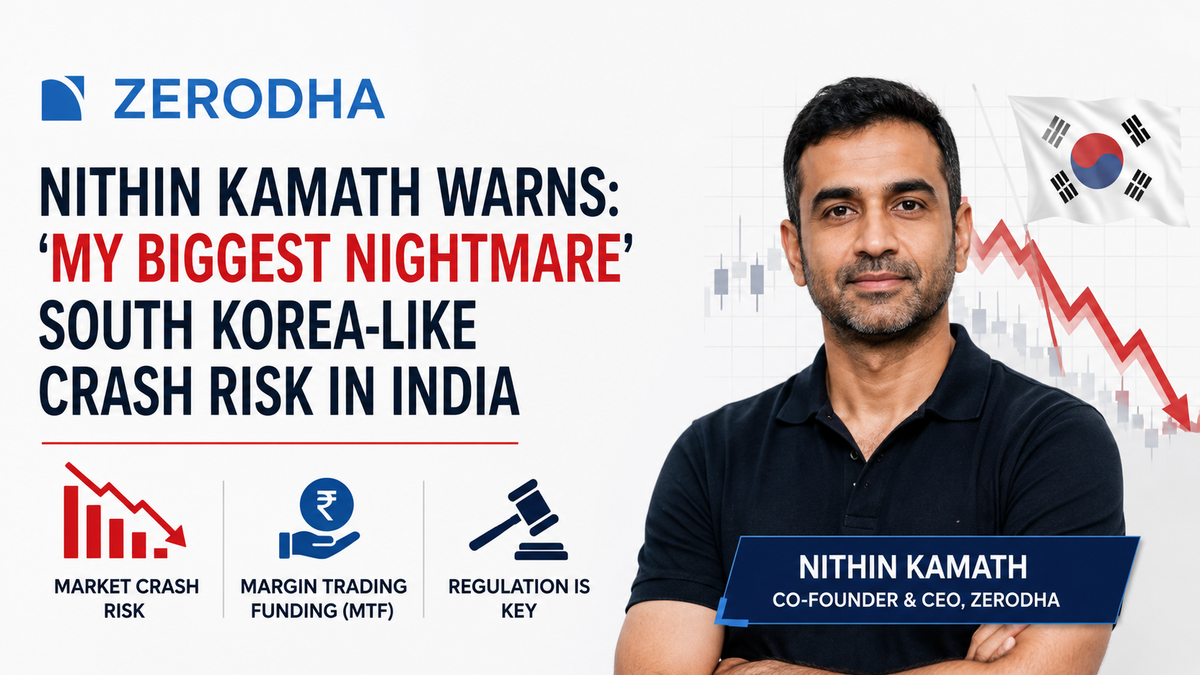
Nithin Kamath Warns of South Korea-Like Crash Risk
Zerodha co-founder Nithin Kamath has raised concerns over the rapid growth of Margin Trading Funding (MTF) in India, calling it the biggest risk his brokerage has faced since its inception.
In a recent post on X, Kamath warned that if Indian equity markets experience a sharp correction, leveraged positions created through MTF could trigger forced selling and accelerate market declines, drawing comparisons with recent developments in South Korea's stock market.
Why Is Kamath Concerned?
According to Kamath, Zerodha's Margin Trading Funding book has grown significantly over the last few years.
Key Highlights
- Zerodha's MTF book is approximately ₹9,000 crore.
- Around 50% of the exposure is in non-F&O stocks.
- Non-F&O stocks can hit consecutive lower circuits during market corrections.
- This makes it difficult for brokers and investors to exit positions during periods of heavy selling.
Kamath described this as the single biggest risk currently facing the brokerage industry.
What Is Margin Trading Funding (MTF)?
Margin Trading Funding allows investors to purchase shares by borrowing money from their broker instead of paying the full amount upfront.
While MTF increases purchasing power during rising markets, it also increases downside risk when prices fall.
As collateral values decline, brokers may issue margin calls requiring investors to either add funds or sell their holdings.
The South Korea Comparison
Kamath compared the current Indian market with recent developments in South Korea.
According to him
- Rising stock prices increase collateral values.
- Higher collateral allows investors to borrow more.
- Increased leverage drives further buying.
- The cycle continues until market momentum reverses.
Once prices begin falling, the process works in reverse.
Declining collateral values trigger margin calls, forcing investors to liquidate positions. This creates additional selling pressure, leading to further declines and more forced selling.
Kamath described this as a self-reinforcing downward spiral that can significantly amplify market corrections.
Why India Could Face Similar Risks
Although India has experienced market volatility before, Kamath noted that Margin Trading Funding has become popular only over the last three to four years.
As a result, the current MTF ecosystem has never been tested during a major market crash at today's scale.
He also highlighted that brokers now offer MTF across nearly 1,500 stocks, increasing the potential breadth of any forced liquidation event.
Small and Mid-Cap Stocks Could Be Most Vulnerable
Kamath believes the biggest impact may be felt in the small-cap and mid-cap segments.
During a sharp correction
- Lower liquidity can worsen declines.
- Consecutive lower circuits may prevent exits.
- Falling collateral values could trigger additional selling.
- Forced liquidation may spread across multiple stocks simultaneously.
This could increase volatility across the broader market.
SEBI's Regulations Offer Some Protection
Despite his concerns, Kamath acknowledged that India's regulatory framework remains stronger than many global markets.
He credited the Securities and Exchange Board of India (SEBI) for maintaining tighter controls on leverage, helping reduce the risk of excessive borrowing.
According to Kamath, these safeguards have so far prevented the kind of leverage-driven market dislocations seen in several international markets.
What This Means for Investors
Kamath's comments do not necessarily indicate that a market crash is imminent. Instead, they highlight the importance of understanding how leverage can amplify both gains and losses.
Investors using Margin Trading Funding should be aware of the risks associated with borrowing, particularly during periods of heightened market volatility. Maintaining appropriate risk management, avoiding excessive leverage, and diversifying investments remain important considerations in uncertain market conditions.
TrendRipperX View
The increasing use of Margin Trading Funding has become an important trend in India's equity markets. While leverage can enhance returns during bull markets, it also increases downside risk during corrections.
Long-term investors should focus on disciplined investing, sound risk management, and avoid taking excessive leveraged positions, especially in volatile small- and mid-cap stocks.
Disclaimer
This article is published solely for educational and informational purposes and should not be considered financial, investment, legal, or tax advice. The information presented is based on publicly available sources and is believed to be accurate at the time of publication; however, TrendRipperX does not guarantee its completeness or accuracy.
TrendRipperX is not registered with the Securities and Exchange Board of India (SEBI) as an Investment Adviser or Research Analyst. Any views expressed are for informational purposes only and do not constitute a recommendation to buy, sell, or hold any security.
Investments in the securities market are subject to market risks. Readers should conduct their own research and consult a SEBI-registered financial advisor before making any investment decisions.
Frequently asked questions
What is the news about Nithin Kamath Warns of South Korea-Like Crash Risk in Indian Markets: Why Margin Trading Funding Is His 'Biggest Nightmare'?
Zerodha co-founder Nithin Kamath has warned that the rapid rise of Margin Trading Funding (MTF) could amplify market corrections in India, drawing comparisons with South Korea's leveraged stock market. Here's what investors need to know.
What should investors know about nithin Kamath Warns of South Korea-Like Crash Risk?
Zerodha co-founder Nithin Kamath has raised concerns over the rapid growth of Margin Trading Funding (MTF) in India, calling it the biggest risk his brokerage has faced since its inception.
Why Is Kamath Concerned?
According to Kamath, Zerodha's Margin Trading Funding book has grown significantly over the last few years.
What should investors know about key Highlights?
Zerodha's MTF book is approximately ₹9,000 crore. Around 50% of the exposure is in non-F&O stocks. Non-F&O stocks can hit consecutive lower circuits during market corrections. This makes it difficult for brokers and investors to exit positions during periods of heavy selling.
What Is Margin Trading Funding (MTF)?
Margin Trading Funding allows investors to purchase shares by borrowing money from their broker instead of paying the full amount upfront.
What should investors know about the South Korea Comparison?
Kamath compared the current Indian market with recent developments in South Korea.
Comments
Comments are moderated. Be civil, no stock tips or promotions.
Loading comments…
Related articles

Closing Market Buzz, 13 September 2026: Policy And Macro Data Tops the Coverage Ahead of Industry And Sectors and IPOs
The most-covered market themes in the closing session on 13 September 2026 — policy and macro data, industry and sectors, IPOs — with our live numbers for each and links to the publishers running the story.

Why Policy And Macro Data Is the Most-Covered Market Story This Midday — 13 September 2026
The most-covered market themes in the midday session on 13 September 2026 — policy and macro data, IPOs, infrastructure — with our live numbers for each and links to the publishers running the story.

Why Banks And NBFCs Is the Most-Covered Market Story This Morning — 13 September 2026
The most-covered market themes in the morning session on 13 September 2026 — banks and NBFCs, policy and macro data, mutual funds — with our live numbers for each and links to the publishers running the story.
Newsletter