

Crude Oil Prices Rise Above $83 Amid Strait of Hormuz Uncertainty
Quick answer
Brent crude oil climbed above $83 per barrel while WTI crude approached $79 as uncertainty surrounding the Strait of Hormuz and fresh geopolitical tensions pushed global oil prices higher.
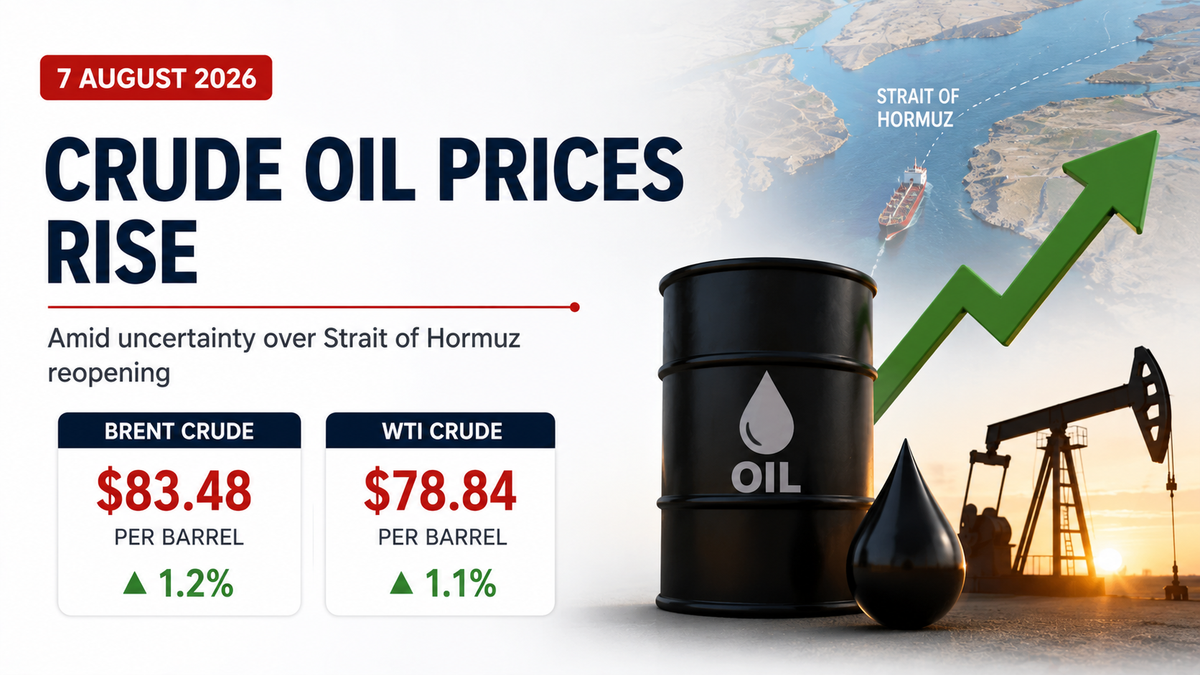
Crude Oil Prices Extend Gains
Global crude oil prices continued their upward momentum on August 7 as geopolitical tensions surrounding the Strait of Hormuz kept investors cautious.
Brent crude futures rose to $83.48 per barrel, gaining 1.2%, while West Texas Intermediate (WTI) crude advanced 1.1% to $78.84 per barrel.
The latest rally follows renewed concerns over shipping access through one of the world's most strategically important energy trade routes.
What's Driving Oil Prices Higher?
Oil prices surged after reports suggested that Iran is reviewing legislation that could impose new restrictions on vessels passing through the Strait of Hormuz.
The proposed measures reportedly include
- Restrictions on vessels considered hostile.
- Heavy financial penalties for violations.
- Transit fees for ships passing through the strait.
The uncertainty has increased concerns over potential disruptions to global crude oil and LNG supplies.
Why the Strait of Hormuz Matters
The Strait of Hormuz is among the world's busiest energy shipping routes.
Before the recent conflict, nearly 20% of global crude oil and liquefied natural gas (LNG) trade passed through this narrow waterway.
Any disruption to shipping activity in the region can significantly impact global energy markets, transportation costs, and inflation expectations.
Diplomatic Uncertainty Continues
Earlier in the week, oil prices had eased as hopes grew for diplomatic progress in the region.
However, the latest developments have revived concerns after reports indicated
- Iran is considering tighter shipping regulations.
- Oman is discussing possible transit fee proposals.
- The United States continues to support unrestricted passage through the Strait of Hormuz.
Market participants remain focused on future diplomatic developments that could influence global oil supply.
Market Impact
Higher crude oil prices are being closely monitored by investors because sustained increases could affect:
- Inflation trends
- Fuel prices
- Transportation and logistics costs
- Corporate profitability
- Equity market sentiment
Energy-sensitive sectors could remain volatile until greater clarity emerges regarding geopolitical developments in the Middle East.
Key Takeaways
- Brent crude climbed to $83.48 per barrel.
- WTI crude rose to $78.84 per barrel.
- Concerns over the Strait of Hormuz continue to support oil prices.
- Proposed shipping restrictions have increased geopolitical uncertainty.
- Global markets remain focused on developments affecting energy supply routes.
Disclaimer
This article is published solely for educational and informational purposes and should not be considered financial, investment, legal, or tax advice. The information presented is based on publicly available sources and is believed to be accurate at the time of publication; however, TrendRipperX does not guarantee its completeness or accuracy.
TrendRipperX is not registered with the Securities and Exchange Board of India (SEBI) as an Investment Adviser or Research Analyst. Any views expressed are for informational purposes only and do not constitute a recommendation to buy, sell, or hold any security.
Investments in financial markets are subject to market risks. Readers should conduct their own research and consult a SEBI-registered financial advisor before making any investment decisions.
Frequently asked questions
What do you need to know about crude Oil Prices Rise Above $83 Amid Strait of Hormuz Uncertainty?
Brent crude oil climbed above $83 per barrel while WTI crude approached $79 as uncertainty surrounding the Strait of Hormuz and fresh geopolitical tensions pushed global oil prices higher.
What does crude Oil Prices Extend Gains mean for markets?
Global crude oil prices continued their upward momentum on August 7 as geopolitical tensions surrounding the Strait of Hormuz kept investors cautious.
What's Driving Oil Prices Higher?
Oil prices surged after reports suggested that Iran is reviewing legislation that could impose new restrictions on vessels passing through the Strait of Hormuz.
Why the Strait of Hormuz Matters?
The Strait of Hormuz is among the world's busiest energy shipping routes.
What does diplomatic Uncertainty Continues mean for investors?
Earlier in the week, oil prices had eased as hopes grew for diplomatic progress in the region.
Why does market Impact matter?
Higher crude oil prices are being closely monitored by investors because sustained increases could affect:.
Comments
Comments are moderated. Be civil, no stock tips or promotions.
Loading comments…
Related articles

Breaking: Silver Rate Jumps 2.14% — 24K at ₹1,53,056 per 10g (21 September 2026)
IBJA silver rates moved 2.14% versus the previous publication. 24K gold at ₹1,53,056 per 10 grams, silver at ₹2,34,562 per kilogram on 21 September 2026.

Breaking: Silver Rate Jumps 3.16% — 24K at ₹1,53,727 per 10g (19 September 2026)
IBJA silver rates moved 3.16% versus the previous publication. 24K gold at ₹1,53,727 per 10 grams, silver at ₹2,36,908 per kilogram on 19 September 2026.

Breaking: Silver Rate Jumps 3.16% — 24K at ₹1,53,727 per 10g (18 September 2026)
IBJA silver rates moved 3.16% versus the previous publication. 24K gold at ₹1,53,727 per 10 grams, silver at ₹2,36,908 per kilogram on 18 September 2026.
Newsletter