

Crude Oil Prices Fall Below $90 as Iran-Oman Hormuz Talks Ease Supply Fears Despite Fresh US Strikes
Quick answer
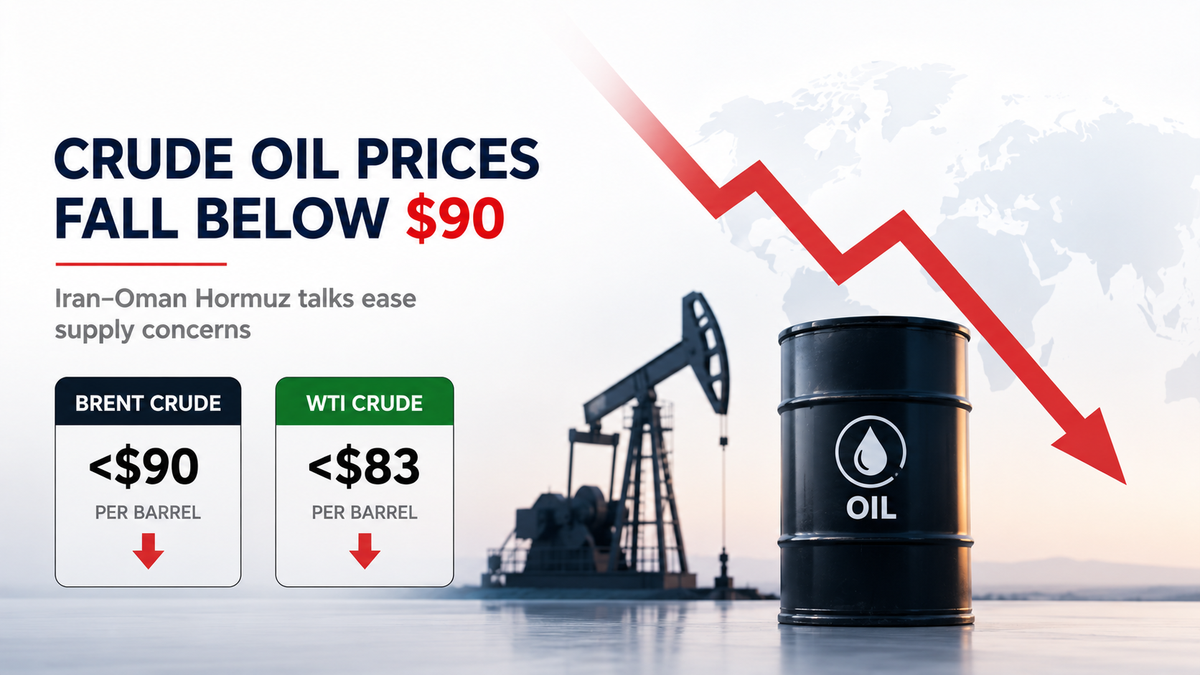
Crude oil prices declined on July 30 as diplomatic talks between Iran and Oman over the Strait of Hormuz eased supply concerns despite fresh US strikes on Iran. Brent crude slipped below $90 while WTI fell under $83.
Crude Oil Prices Decline After Sharp Rally
Global crude oil prices moved lower on 30 July 2026, giving back a portion of the previous session's strong gains as investors assessed diplomatic developments involving Iran and Oman over the strategic Strait of Hormuz.
Despite renewed military strikes by the United States on Iran, hopes that shipping through one of the world's most critical oil transit routes could remain operational helped cool market fears.
Both major crude benchmarks traded lower during the session.
Oil Price Snapshot
Brent Crude
- Traded below $90 per barrel
- Had surged nearly 8% in the previous trading session
WTI Crude
- Slipped below $83 per barrel
- Gave back part of the previous day's 6.5% rally
The decline reflected easing concerns over immediate supply disruptions rather than a resolution of broader geopolitical risks.
Iran-Oman Talks Support Market Sentiment
Investor sentiment improved after reports suggested that Iran and Oman continue discussions regarding the management of shipping through the Strait of Hormuz.
According to reports, Iran has proposed a joint operational framework under which
- Iran would manage shipping traffic in one direction.
- Oman would oversee vessels traveling in the opposite direction.
Although negotiations are still ongoing, the discussions indicate that both countries are seeking ways to keep commercial shipping moving through the vital waterway.
Why the Strait of Hormuz Matters
The Strait of Hormuz remains one of the world's most important energy corridors.
Key Facts
- Nearly 20% of global seaborne crude oil passes through the Strait.
- It is the primary export route for several Middle Eastern oil producers.
- Any disruption can immediately impact global crude prices and energy markets.
Because of its strategic importance, developments surrounding the Strait are closely monitored by traders worldwide.
Geopolitical Risks Still Remain
Although oil prices eased during the session, geopolitical tensions remain elevated.
Recent developments include
- Fresh US military strikes targeting Iran.
- Continued threats from Iran's Islamic Revolutionary Guard Corps (IRGC).
- Ongoing uncertainty surrounding regional security.
- Concerns over the safety of commercial shipping routes.
These developments continue to create uncertainty for global energy markets.
Additional Supply Risks
Apart from tensions in the Gulf region, traders are also watching other supply-related developments.
Red Sea Shipping
Reports suggest Yemen's Houthi group is considering transit fees for commercial vessels using the southern Red Sea, another important global shipping route.
Black Sea Disruptions
Loading activity at the Caspian Pipeline Consortium (CPC) terminal was also affected after reports of an incident involving an oil tanker during loading operations.
Any prolonged disruption across these routes could tighten global oil supplies.
What This Means for Global Markets
Crude oil remains one of the biggest drivers of inflation and market sentiment worldwide.
Lower oil prices generally benefit
- Oil-importing countries such as India.
- Airlines and transportation companies.
- Manufacturing businesses with high fuel costs.
- Consumers through lower fuel inflation.
However, if geopolitical tensions escalate further or shipping disruptions occur, crude prices could quickly become volatile again.
Key Takeaways
- Brent crude slipped below $90 per barrel.
- WTI crude traded below $83 per barrel.
- Iran and Oman continued discussions on managing shipping through the Strait of Hormuz.
- Diplomatic progress helped ease immediate supply concerns.
- Geopolitical tensions remain elevated following renewed US-Iran military actions.
- Traders continue to monitor developments across the Middle East, Red Sea, and Black Sea for potential supply disruptions.
Final Thoughts
Crude oil prices retreated after a sharp rally as diplomatic talks between Iran and Oman reduced immediate fears of supply disruptions through the Strait of Hormuz. While this provided short-term relief to energy markets, ongoing geopolitical tensions and uncertainty surrounding key global shipping routes continue to pose risks.
Investors should expect crude oil prices to remain highly sensitive to geopolitical developments, making volatility a key theme in the coming weeks.
Disclaimer
This article is published solely for educational and informational purposes and should not be considered financial, investment, legal, or tax advice. The information presented is based on publicly available sources and is believed to be accurate at the time of publication; however, TrendRipperX does not guarantee its completeness or accuracy.
TrendRipperX is not registered with the Securities and Exchange Board of India (SEBI) as an Investment Adviser or Research Analyst. Any views expressed are for informational purposes only and do not constitute a recommendation to buy, sell, or hold any security.
Investments in the securities market are subject to market risks. Readers should conduct their own research and consult a SEBI-registered financial advisor before making any investment decisions.
Frequently asked questions
What is the news about Crude Oil Prices Fall Below $90 as Iran-Oman Hormuz Talks Ease Supply Fears Despite Fresh US Strikes?
Crude oil prices declined on July 30 as diplomatic talks between Iran and Oman over the Strait of Hormuz eased supply concerns despite fresh US strikes on Iran. Brent crude slipped below $90 while WTI fell under $83.
What should investors know about crude Oil Prices Decline After Sharp Rally?
Global crude oil prices moved lower on 30 July 2026, giving back a portion of the previous session's strong gains as investors assessed diplomatic developments involving Iran and Oman over the strategic Strait of Hormuz.
What should investors know about iran-Oman Talks Support Market Sentiment?
Investor sentiment improved after reports suggested that Iran and Oman continue discussions regarding the management of shipping through the Strait of Hormuz.
Why the Strait of Hormuz Matters?
The Strait of Hormuz remains one of the world's most important energy corridors.
What should investors know about geopolitical Risks Still Remain?
Although oil prices eased during the session, geopolitical tensions remain elevated.
What should investors know about additional Supply Risks?
Apart from tensions in the Gulf region, traders are also watching other supply-related developments.
Comments
Comments are moderated. Be civil, no stock tips or promotions.
Loading comments…
Related articles

Breaking: Silver Rate Drops 2.02% — 24K at ₹1,51,938 per 10g (12 September 2026)
IBJA silver rates moved 2.02% versus the previous publication. 24K gold at ₹1,51,938 per 10 grams, silver at ₹2,28,920 per kilogram on 12 September 2026.

Breaking: Silver Rate Drops 2.27% — 24K at ₹1,53,018 per 10g (11 September 2026)
IBJA silver rates moved 2.27% versus the previous publication. 24K gold at ₹1,53,018 per 10 grams, silver at ₹2,29,900 per kilogram on 11 September 2026.

Gold Rate Today (11 September 2026): 24K at ₹1,53,018 per 10g, Silver at ₹2,29,900 per kg
Official IBJA gold and silver rates for 11 September 2026 — 24K, 22K, 18K gold per 10 grams, silver per kilogram, plus live MCX commodity futures.
Newsletter