

BSE Share Price: Closing Auction Session Turmoil Clouds Growth Outlook
Quick answer
BSE shares have fallen more than 9% in August as concerns over the new Closing Auction Session weigh on options turnover and trading volumes. Analysts have also raised questions about the exchange's near-term earnings and growth outlook.
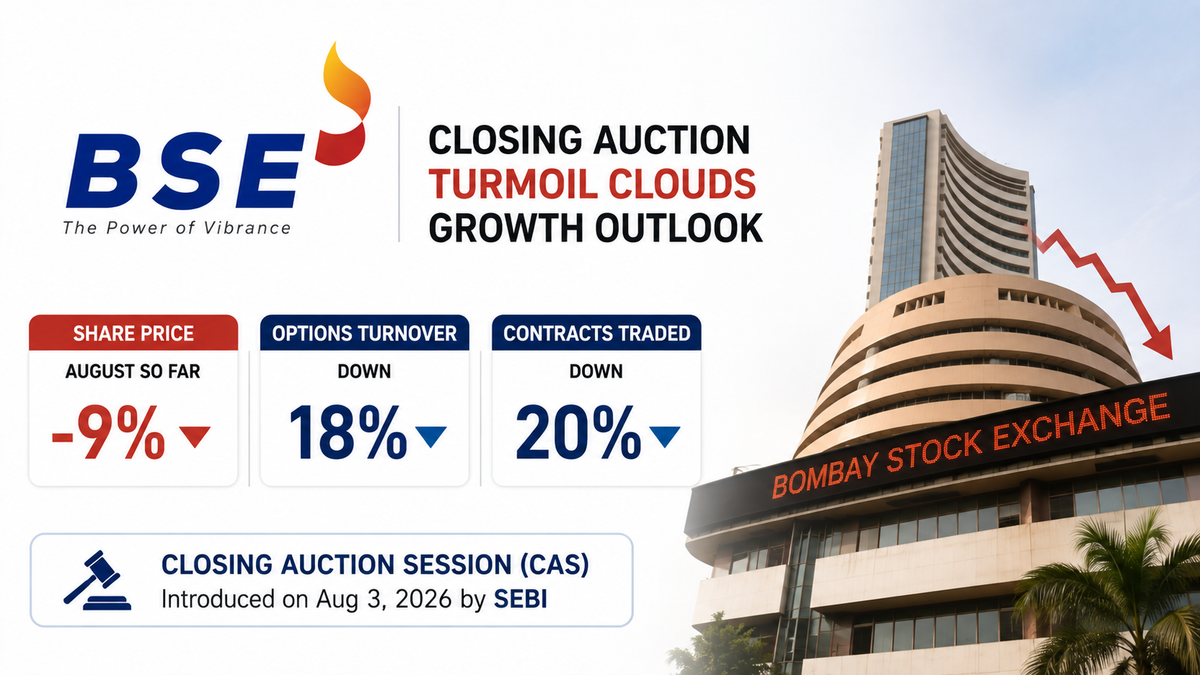
BSE Share Price in Focus
BSE Ltd. shares have come under pressure in August as concerns surrounding the exchange's newly introduced Closing Auction Session (CAS) raise questions about its near-term growth and earnings outlook.
BSE shares have fallen more than 9% in August so far, according to the reported data.
The new closing auction mechanism was introduced on August 3, 2026, as part of efforts to improve closing-price discovery and align India's market structure more closely with global practices.
However, the implementation has been followed by concerns around trading activity, particularly in the options segment.
BSE Share Price and Closing Auction Highlights
August Performance: Down more than 9%
Closing Auction Session Introduced: August 3, 2026
Options Premium Turnover: Down 18%
Contracts Traded: Down 20%
Period Compared: August 6 and August 13 expiries vs July weekly expiries
Analysts Tracking BSE: 18
Consensus Upside: Around 20%
Market Regulator: SEBI
Stock Exchange: BSE Ltd.
What Is the Closing Auction Session?
The Closing Auction Session is designed to improve the process used to determine the closing price of securities.
The mechanism is modelled on frameworks used in several developed markets and is intended to strengthen price discovery and reduce the possibility of market manipulation around closing prices.
The new system became operational on August 3.
However, the introduction has generated concerns among market participants about its impact on trading activity, particularly in derivatives.
Despite complaints and concerns surrounding the implementation, India's market regulator Securities and Exchange Board of India (SEBI) has indicated that the mechanism will remain in place.
BSE Options Turnover Declines
One of the biggest concerns for investors has been the decline in options activity following the introduction of the new auction mechanism.
According to Bloomberg data cited in the report, BSE's average daily premium turnover declined approximately 18% for the August 6 and August 13 expiries compared with the average for weekly expiries in July.
The number of contracts traded also declined by approximately 20% during the period.
The change in trading activity has raised questions about whether the impact could extend to BSE's earnings if lower volumes persist.
Analysts Cut BSE Ratings
The concerns surrounding trading volumes have also resulted in changes to analyst views on the stock.
Jefferies Financial Group downgraded BSE to underperform, marking the first reported sell recommendation on the stock since October.
Nuvama also downgraded the stock to hold and reduced its price target by 20%.
Despite these downgrades, the overall analyst view remains mixed.
More than half of the 18 analysts tracking BSE still have buy ratings, while the 12-month consensus price target reportedly implies around 20% upside.
BSE Market Share and Growth Concerns
Nuvama has highlighted concerns about BSE's ability to generate additional market-share gains in the near term.
The brokerage noted that BSE's contract-market share is around 50%, while incremental growth levers may have become more limited.
According to the reported analyst commentary, this could mean that BSE's market share remains broadly flat in fiscal years FY28 and FY29.
Such an outlook could increase downside risks to earnings if options volumes do not recover as expected.
BSE Could Explore Higher Fees
Analysts have suggested that BSE could potentially explore measures to improve profitability if trading volumes remain under pressure.
One possible strategy could involve increasing options fees and messaging fees associated with its co-location facility.
Such measures could help offset some of the pressure from lower volumes.
However, investors may continue to value BSE primarily on its ability to deliver sustainable volume-led growth, making the recovery in trading activity an important factor to monitor.
BSE Options Volumes: What Happens Next?
According to Jefferies analyst Supratim Datta, BSE's average daily turnover could recover from October once issues surrounding the closing auction process are resolved.
However, the analyst expects BSE's market share to remain broadly flat in FY28 and FY29.
The expected recovery in turnover could therefore become an important catalyst for the stock, while weaker-than-expected volumes could increase pressure on earnings expectations.
RBI Funding Rules Add Another Challenge
BSE also faces another potential headwind following changes to funding rules related to proprietary trading by the Reserve Bank of India.
Nuvama has highlighted the tightening of funding rules as an additional challenge for the exchange.
The impact of these changes on derivatives activity and overall trading volumes will be another factor investors may monitor.
Why BSE Growth Matters
BSE has emerged as an important player in India's rapidly expanding derivatives market.
Higher trading volumes can support exchange revenue through transaction fees, while increasing market share can improve operating leverage and profitability.
As a result, changes in options turnover and contract volumes are closely watched by investors.
The current debate around the Closing Auction Session is therefore not only about the technical functioning of the mechanism but also about its potential impact on BSE's revenue growth.
BSE Share Price: What to Watch
Investors tracking BSE may focus on whether trading activity stabilises following the initial impact of the Closing Auction Session.
Key factors to watch include
Options turnover: Whether premium turnover recovers from the recent decline.
Contract volumes: Whether the number of contracts traded returns toward previous levels.
Market share: Whether BSE can maintain or increase its share of the derivatives market.
October recovery: The expected recovery in average daily turnover will be an important development to monitor.
Fee changes: Potential changes to options and messaging fees could affect future revenue.
Regulatory developments: Further developments around the Closing Auction Session could influence investor sentiment.
Earnings outlook: Changes in trading volumes and market share could affect future earnings expectations.
BSE Share Price Outlook
The near-term outlook for BSE is likely to remain closely linked to derivatives activity and the market's response to the Closing Auction Session.
A recovery in turnover and trading volumes could ease concerns around earnings growth.
On the other hand, if lower volumes persist for longer than expected, analysts could reassess earnings estimates and valuations.
The stock therefore remains sensitive to both regulatory developments and changes in trading activity.
Key Takeaways
BSE shares have fallen more than 9% in August amid concerns surrounding the newly introduced Closing Auction Session.
The mechanism was introduced on August 3, 2026, with the objective of improving closing-price discovery and aligning India's market structure with global practices.
BSE's average daily premium turnover declined 18% for the August 6 and August 13 expiries compared with July weekly expiries, while contracts traded declined 20%, according to the reported Bloomberg data.
Jefferies downgraded BSE to underperform, while Nuvama reduced its rating to hold and cut its price target by 20%.
More than half of the 18 analysts tracking the stock still reportedly maintain buy ratings.
The recovery of BSE's trading volumes, particularly in options, will remain a key factor for the company's future growth and earnings outlook.
Disclaimer
This article is published solely for educational and informational purposes.
TrendRipperX is not registered with the Securities and Exchange Board of India (SEBI) as an Investment Adviser or Research Analyst.
The information presented in this article is based on publicly available information and is intended only for general market awareness and educational purposes.
Nothing in this article should be interpreted as a buy, sell, hold, entry or exit recommendation from TrendRipperX.
Analyst ratings, price targets and market expectations can change. Trading volumes and market-share data may also fluctuate significantly.
Readers should conduct their own independent research and consult a SEBI-registered financial professional before making any investment decision.
Frequently asked questions
BSE Share Price: Closing Auction Session Turmoil Clouds Growth Outlook — what exactly happened?
BSE shares have fallen more than 9% in August as concerns over the new Closing Auction Session weigh on options turnover and trading volumes. Analysts have also raised questions about the exchange's near-term earnings and growth outlook.
What does BSE Share Price in Focus mean for markets?
BSE Ltd. shares have come under pressure in August as concerns surrounding the exchange's newly introduced Closing Auction Session (CAS) raise questions about its near-term growth and earnings outlook.
What Is the Closing Auction Session?
The Closing Auction Session is designed to improve the process used to determine the closing price of securities.
What is happening with BSE Options Turnover Declines?
One of the biggest concerns for investors has been the decline in options activity following the introduction of the new auction mechanism.
What are the key points on analysts Cut BSE Ratings?
The concerns surrounding trading volumes have also resulted in changes to analyst views on the stock.
Why is BSE Market Share and Growth Concerns a concern?
Nuvama has highlighted concerns about BSE's ability to generate additional market-share gains in the near term.
Comments
Comments are moderated. Be civil, no stock tips or promotions.
Loading comments…
Related articles

IPOs Leads the Morning Market Talk on 11 September 2026, Policy And Macro Data and Mutual Funds Close Behind
The most-covered market themes in the morning session on 11 September 2026 — IPOs, policy and macro data, mutual funds — with our live numbers for each and links to the publishers running the story.

Breaking: Nifty Tumbles 1.76% to 23,477.80 on 11 September 2026
The Nifty 50 is down 1.76% at 23,477.80 as of 12:00 am IST. Live breadth, sector damage and the biggest movers behind the move.

IPOs Leads the Evening Market Talk on 10 September 2026, Policy And Macro Data and Mutual Funds Close Behind
The most-covered market themes in the evening session on 10 September 2026 — IPOs, policy and macro data, mutual funds — with our live numbers for each and links to the publishers running the story.
Newsletter